
Rhinoplasty is the surgery that changes the shape, the size or the function of the nose. Because it sits at the centre of the face, a change of millimetres is read across the whole of it: which is why planning does not start from an ideal nose, but from yours and from the rest of your features.
It is also one of the procedures where appearance and function overlap most often. It is common for someone to come in about their profile and for the assessment to also turn up a deviated septum that explains years of sleeping badly or breathing through the mouth. When that happens, both can be resolved in the same operation.
It usually helps when there is
- A prominent bridge or a drooping tip that dominate the profile.
- A nose that sits off the midline of the face.
- Difficulty breathing through one nostril or through both.
- A wide, bulbous or poorly defined tip.
- A previous result that did not work out, whether ours or from another surgery.
Worth discussing first if
- Facial growth has not finished yet.
- What is expected is a different face, rather than a different nose.
- Smoking: it compromises healing and has to be stopped.
- An uncontrolled health condition or treatment with blood thinners.
- A personal moment of real instability.
None of these rules the procedure out on its own; all of them change the conversation.
Cosmetic, functional or both
Not every rhinoplasty is after the same thing, and they are not all equally complex. These are the three usual scenarios, and which one your case belongs to is precisely what the consultation is for.
Cosmetic rhinoplasty
Works on the proportion of the bridge, the definition of the tip and the profile, so that the nose stops being the first thing you see in the face.
Functional rhinoplasty
Corrects what gets in the way of breathing: a deviated septum, enlarged turbinates or collapse of the nasal valve. It can be done together with the cosmetic part.
Secondary rhinoplasty
A second operation on a nose that has already been operated on. It is the most demanding: there is scar tissue, and it usually calls for grafts of your own cartilage.
How your nose is decided
The technique is not chosen because it is fashionable. The skin, the cartilage, the bone and the airway are examined, and from there comes the decision on whether an open or a closed approach suits, whether grafts of your own cartilage are needed for support, and what has to be preserved.
That last part matters more than it sounds. A nose that has structure taken away without support being given back can look fine at three months and give way years later. That is why planning looks as much at the immediate result as at how the tissue will behave over time.
From consultation to discharge
Between deciding and being operated on there is a path with defined stages. Knowing them helps you organise your time, your work and who will be with you.
Consultation and planning
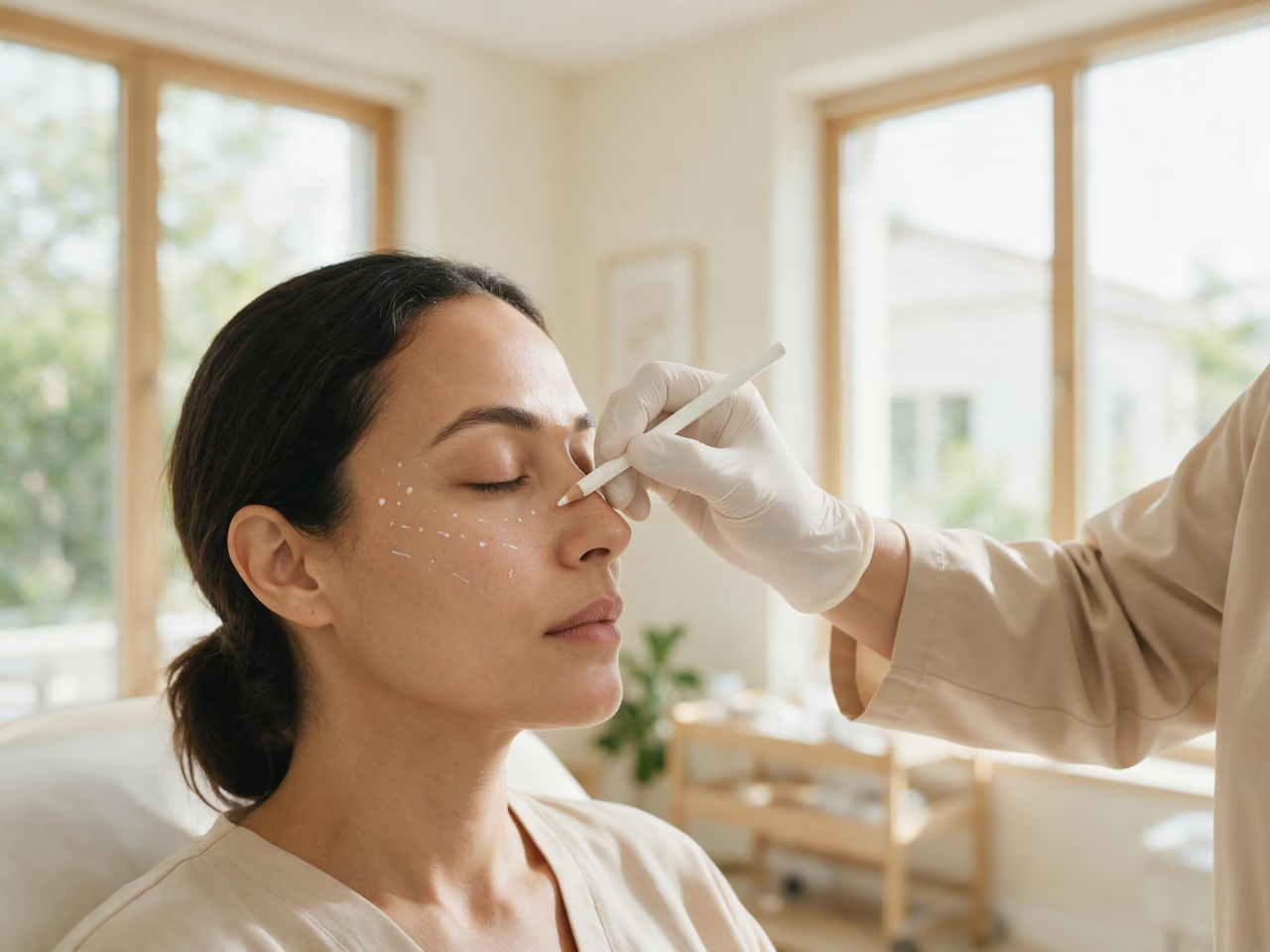
Your nose, your breathing and your face as a whole are assessed, and we talk about what you are hoping for. You leave with the alternatives explained, their risks, and a written quote.
Pre-operative work-up
Laboratory tests, assessment by the anaesthetist and, depending on the case, other referrals. You will be told to stop smoking and to stop certain medicines in advance.
The surgery
In a licensed surgical facility, under general anaesthesia and with an anaesthetist present throughout. An external splint is placed at the end.
Follow-up
The splint comes off around the seventh day, with scheduled check-ups through the first year, which is how long a nose takes to settle completely.
Recovery, week by week
What surprises people about a rhinoplasty is not the surgery but the patience it asks for afterwards. An operated nose comes down in layers, and over months.
-
First 48 hours
Congestion, pressure and swelling — more discomfort than pain. Rest with the head raised and cold on the cheekbones, never directly on the nose.
-
Around day 7
The splint comes off. The bruising starts to fade and the face begins to look like itself again, still visibly swollen.
-
Weeks 2 to 4
Social life and desk work, with the swelling still more visible to you than to anyone else. No impact exercise and no glasses resting on the bridge.
-
Months 2 to 6
The swelling drops clearly and the shape appears. The tip is the last area to come down, which is why it is the one that tries your patience most.
-
Around 12 months
This is taken as the final result. In secondary rhinoplasties or in thick skin it can take longer.
Risks, and what is not promised
All surgery carries risks, and rhinoplasty is no exception: bleeding, infection, healing problems, breathing difficulties, asymmetries or irregularities that show up as the swelling goes down. A percentage of patients, even with correct surgery, need a later revision.
These risks are reduced by a sound indication, complete pre-operative tests, a licensed surgical facility and serious follow-up. They are not eliminated. The ones that apply to your case are explained to you in the consultation and set down again in writing in the informed consent you sign before surgery.
The information on this page is for guidance and does not replace an in-person medical consultation. Medical practice is an obligation of means, not of result.
What people ask most about rhinoplasty
The aim is not a recognisable nose but one that fits your face. Planning sets out to preserve your features and to avoid the standardised nose that gives the surgery away.
That said, no surgeon can guarantee an exact result: your anatomy, the thickness of your skin and the way you heal all take part in the final outcome.
Less than people fear. What bothers most in the first few days is the congestion, the blocked feeling and the pressure across the face, rather than pain. It is managed with the medication written down for you at discharge.
Pain that increases instead of easing is not part of the process: it is a reason to call us.
When the case calls for it, osteotomies are performed — controlled, planned cuts in the nasal bone, not a random fracture. They are not needed in every rhinoplasty.
If they are indicated in your case, you are told before surgery and it is recorded in the informed consent you sign.
With the closed technique the incisions stay inside the nose. With the open technique a small incision is added on the columella, the bridge of skin between the nostrils, which usually becomes hard to notice over time.
The choice is not a matter of fashion: it depends on what has to be corrected and on whether direct sight of the structures is needed. It is decided in the consultation and you are told why.
In the consultation we work with images and references to give the conversation structure and to check that surgeon and patient are talking about the same thing.
It is a tool for communicating, not a commitment to a result. No simulation can anticipate how a particular tissue will heal.
Yes, and it is usual: it is called septorhinoplasty, and it saves going through theatre and recovery twice. It is common for someone to come in about their profile and for the assessment to also pick up a deviation that explains years of breathing badly.
As for insurance cover, that depends on your policy and on how the functional component is indicated. It is something to confirm directly with your insurer.
We do not publish prices, because the cost depends on the technique indicated, on how long the procedure takes and on the surgical facility: any figure on its own would end up being wrong for your case.
After the consultation you receive a written quote, itemising what is and is not included, and how long it is valid for.
Question not answered here? There are more answers in the frequently asked questions.